
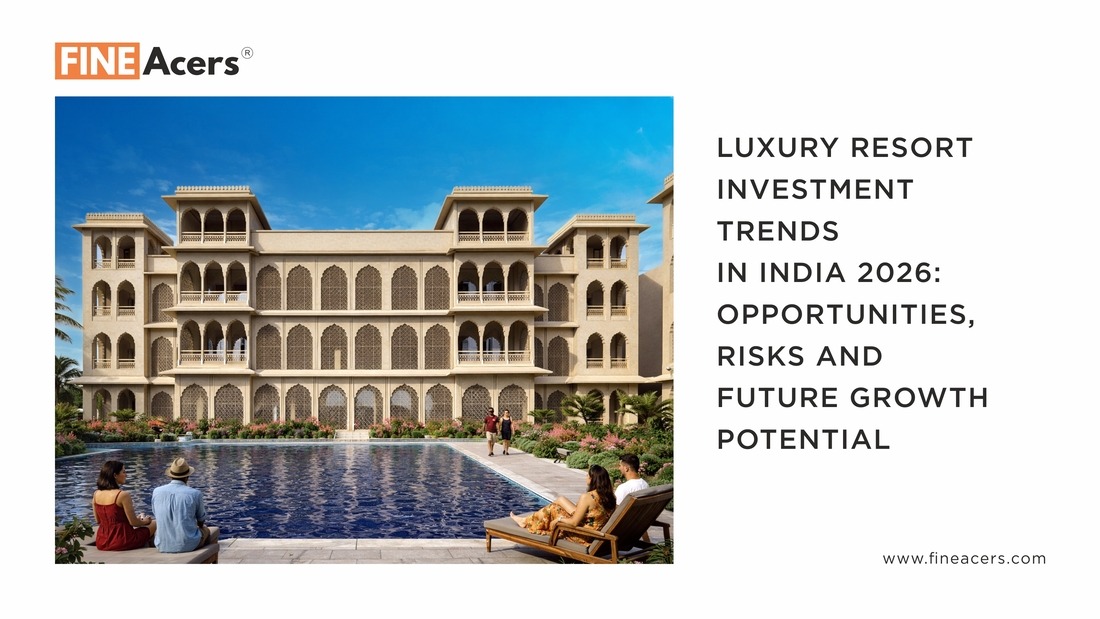
Introduction: Hospitality Real Estate Enters a More Mature Phase
Luxury resort investment in India is moving from a niche proposition toward a more recognised segment of hospitality-backed real estate. The shift is being supported by domestic tourism, premium leisure demand, branded hotel expansion, improving connectivity, and growing investor interest in professionally operated hospitality assets.
The market entered 2026 with encouraging fundamentals. According to HVS ANAROCK, India’s hotel sector closed 2025 with nationwide occupancy of approximately 63–65%, average room rates of about ₹8,500–₹8,700, and RevPAR of roughly ₹5,400–₹5,600. HVS attributed this performance partly to disciplined supply growth and consumers’ willingness to pay for quality experiences.
ICRA expects pan-India premium hotel occupancy to remain around 72–74% in FY2026, compared with 70–72% in FY2024 and FY2025. It also projects premium average room rates of approximately ₹8,200–₹8,500 for FY2026, supported by domestic leisure travel, business travel, weddings, and MICE demand.
For investors, however, a strong hospitality market does not mean that every resort project will perform equally well. Location, brand strength, development quality, operating efficiency, ownership structure, documentation, and exit terms remain critical.
The 2026 opportunity is therefore not simply about investing in a resort. It is about selecting a hospitality asset with the right destination, positioning, operator, financial structure, and long-term strategy.
Why Luxury Resort Investments Are Attracting Attention
Traditional real estate generally creates value through rental income and appreciation. Luxury resort investments add another dimension by linking the physical asset to an operating hospitality business.
A professionally managed resort may benefit from:
- Tourism and leisure demand
- Room revenue and guest spending
- Branded hospitality positioning
- Destination appreciation
- Professional marketing and distribution
- Premium lifestyle privileges
- Managed ownership structures
This combination appeals to investors who want tangible real estate exposure without personally managing tenants, bookings, maintenance, staff, or guest services.
Investor interest in hospitality assets has already strengthened. JLL reported that India’s hotel investment market reached USD 567 million across 28 transactions in 2025, representing a 67% increase over 2024. Luxury assets accounted for 42% of the transaction volume, while upscale properties contributed another 41%.
The momentum continued into 2026. Hotel transactions reached USD 185 million in the first quarter of 2026, around 58% higher than the corresponding period of 2025.
These numbers represent institutional hotel transactions rather than individual resort-unit purchases, but they illustrate growing confidence in the hospitality sector and the increasing importance of premium assets.
Trend 1: Growth Is Moving Beyond Major Metropolitan Cities
One of the most important hospitality trends in 2026 is the expansion of branded properties into Tier II, Tier III, and emerging tourism markets.
JLL reported 51,647 branded hotel keys signed across 424 properties in 2025, with 71% of the signed inventory concentrated in Tier II and Tier III cities. It also noted that these markets accounted for 40% of transaction volume, including activity in destinations such as Goa, Udaipur, Rishikesh, Lonavala, and Nashik.
HVS ANAROCK similarly observed that hotel development is no longer concentrated only in major metros. Improving connectivity, lower development costs, local demand, and decentralising economic activity are supporting hospitality growth across smaller cities and destination markets.
This trend creates opportunities for resort developments in places with strong natural, cultural, spiritual, coastal, or experiential appeal.
Fine Acers follows a destination-led approach across locations such as Jaipur, Udaipur, Goa, Jawai, Coorg, Pushkar, and Sakleshpur. These destinations represent different tourism themes, ranging from heritage and coastal leisure to wildlife, wellness, spirituality, and nature-based travel.
For investors, such diversification matters because tourism demand is not identical across destinations. A coastal resort, wildlife retreat, heritage property, and plantation resort may attract different guests and operate across different travel seasons.
Trend 2: Branded Hospitality Is Becoming More Important
As resort supply expands, branding is becoming increasingly important to guest confidence and investor assessment.
A hospitality brand can contribute through:
- Defined service standards
- Professional reservation systems
- Revenue management
- Distribution across booking platforms
- Staff training and operational processes
- Market positioning
- Guest trust
- Quality control
Branding does not guarantee occupancy, profitability, or appreciation. However, it can provide a resort with a clearer identity and a more organised operating framework than an independently managed holiday property.
Fine Acers’ portfolio includes Dolce Resorts by Wyndham in Goa and Udaipur; KAMAH Hotels & Resorts under Trademark Collection by Wyndham in Jawai and Coorg; Wyndham Grand Jaipur Amer; Re:Gen:Ta Resort & Spa in Pushkar; and The Ame Resorts in Sakleshpur.
The increasing preference for management-led hospitality structures is also visible in wider industry data. JLL reported that management contracts accounted for 84% of branded hotel signings in 2025, rising from 81% a year earlier.
For an investor, this highlights the importance of looking beyond the physical construction. The experience, operator, brand agreement, distribution capability, and management structure can significantly influence the long-term positioning of the resort.
Trend 3: Experiential Hospitality Is Driving Premium Demand
Luxury travel is increasingly defined by experiences rather than accommodation alone.
Modern resort guests may seek:
- Wellness and rejuvenation
- Nature and wildlife
- Local culture and cuisine
- Privacy and low-density environments
- Scenic landscapes
- Premium leisure
- Personalised hospitality
- Meaningful family experiences
HVS reported that Indian hotels maintained pricing power during 2025 partly because consumers showed a growing willingness to pay for quality experiences.
This supports resort formats that offer a strong destination identity rather than a generic room product.
Jawai, for example, can be positioned around wildlife and nature. Udaipur combines lakes, heritage, and luxury hospitality. Goa serves coastal and leisure demand. Coorg and Sakleshpur offer greenery, plantation landscapes, and wellness-oriented experiences. Pushkar combines spirituality and culture, while Jaipur offers heritage, connectivity, and established premium tourism.
A resort that is genuinely connected to its location may be better placed to create a distinctive guest proposition. For investors, that differentiation can be more valuable than simply owning a unit in a large, undifferentiated development.
Trend 4: Professionally Managed Ownership Is Gaining Relevance
Many investors are interested in hospitality real estate but do not want to operate a hotel business.
Professionally managed resort ownership addresses this through a separation between ownership and operations. Under such structures, the investor owns the specified asset while the developer, operator, or appointed hospitality company manages the resort.
Operational responsibilities may include:
- Reservations and pricing
- Staff and housekeeping
- Guest acquisition
- Maintenance
- Food and beverage
- Marketing
- Vendor management
- Brand compliance
- Property upkeep
Fine Acers structures selected opportunities through resort ownership and Sale-Lease-Back models. The objective is to provide investors with a hospitality-backed asset while keeping day-to-day operations under professional management.
This model may be attractive to business owners, professionals, NRIs, and investors seeking a more passive real estate experience. However, the exact lease tenure, return structure, operating responsibilities, maintenance obligations, usage rights, and exit terms must be verified in the applicable project agreement.
Trend 5: Lifestyle Benefits Are Becoming Part of the Investment Proposition
Luxury resort ownership is often promoted through a combination of financial and lifestyle benefits.
Depending on the project, these may include:
- Complimentary holidays
- Domestic or international stays
- Resort usage rights
- Premium hospitality experiences
- Special celebration benefits
- Professional maintenance
- Assured returns or buyback arrangements
These benefits can make resort ownership more emotionally appealing than conventional rental property. The investor may receive personal utility from the asset in addition to its potential financial value.
Fine Acers integrates lifestyle privileges into selected resort ownership structures, including complimentary stays and premium hospitality experiences.
Investors should nevertheless examine the practical value of such benefits. Important questions include the number of nights offered, eligible properties, blackout dates, booking procedures, transferability, taxes, validity periods, and whether benefits continue after the lease or operating agreement ends.
Opportunity 1: Exposure to India’s Domestic Travel Economy
Domestic travel remains one of the strongest foundations of India’s hospitality market.
HVS identifies domestic travel as the sector’s most dependable demand anchor entering 2026, supported by improving infrastructure and a widening tourism base.
This is particularly relevant for resort investments because many destination properties depend on weekend travel, family holidays, road trips, short leisure breaks, celebrations, and wellness stays.
Resorts located within accessible distance of major urban centres may benefit from frequent short-duration demand, while established tourism destinations can attract a wider national and international audience.
The opportunity is strongest where a destination offers both emotional appeal and practical accessibility.
Opportunity 2: Potential for Asset Appreciation
Resort investment can create value at multiple levels.
The underlying land may appreciate as infrastructure and connectivity improve. The completed resort may gain additional value through development quality, brand positioning, amenities, and operating performance. The destination itself may become more established as tourism supply and visibility expand.
Fine Acers’ land-to-resort philosophy is based on transforming selected land into branded, professionally managed hospitality assets.
However, appreciation should never be assumed. It depends on acquisition cost, development quality, market conditions, destination growth, approvals, supply competition, asset maintenance, and investor demand at the time of resale.
A resort investment should therefore be evaluated on realistic assumptions rather than projected appreciation alone.
Opportunity 3: Branded Expansion in Emerging Destinations
The movement of branded hospitality into smaller and destination-led markets can create early-stage opportunities for investors.
Greenfield branded development reached 33,170 keys in 2025, around 17% higher than the previous year, according to JLL.
For investors, the opportunity may lie in destinations where:
- Tourism demand is already visible
- Connectivity is improving
- Premium branded supply remains limited
- Land prices have not fully matured
- The resort has a differentiated concept
- The development is professionally executed
The challenge is distinguishing genuine destination growth from speculative marketing. Investors should verify current hotel demand, access, nearby attractions, infrastructure, competing supply, and the project’s development status.
Key Risk 1: Operating Costs Can Reduce Profitability
Hospitality assets are operationally intensive. Revenue growth does not automatically translate into proportional profit growth.
Hotels must manage staffing, utilities, repairs, food costs, sales commissions, technology, insurance, brand fees, refurbishment, and service standards.
HVS has highlighted rising labour expenses, utilities, insurance, brand-related costs, and shared-service allocations as pressures on hotel profitability. It notes that owners increasingly need active asset management and operating realignment to protect margins.
An investor assessing a resort opportunity should understand whether quoted returns are fixed under contract, linked to actual performance, or supported through another financial arrangement.
Key Risk 2: Construction and Completion Risk
Under-construction resort projects involve risks relating to approvals, funding, execution, contractor performance, material costs, and completion schedules.
Investors should verify:
- Land title and ownership
- Relevant development approvals
- Construction status
- Project funding
- Delivery commitments
- Compensation provisions
- Registration documentation
- Brand agreement status
The strength of the hospitality concept matters only if the property is completed and operated according to the promised standards.
Key Risk 3: Brand and Operator Dependency
A branded resort can benefit from professional standards and distribution, but it may also depend heavily on the continued brand and operator relationship.
Investors should understand:
- The duration of the brand agreement
- Termination provisions
- Performance obligations
- Management and franchise fees
- Responsibility for brand-standard upgrades
- What happens if the operator changes
- Whether ownership benefits survive a branding change
The presence of an international or national brand should be verified through official documentation rather than promotional communication alone.
Key Risk 4: Liquidity and Exit Limitations
A resort unit may not be as liquid as a conventional apartment in a large residential market.
The buyer pool can be narrower, resale may require operator approval, and the unit may remain subject to a lease or management arrangement.
Where assured buyback is offered, investors should examine:
- The entity providing the buyback
- Buyback timing
- Eligibility conditions
- Pricing or appreciation formula
- Payment process
- Default provisions
- Financial capacity of the obligated entity
An assured buyback is only as dependable as the agreement and the party responsible for fulfilling it.
Key Risk 5: Seasonality and Destination Dependence
Resort demand can vary with weather, holidays, school calendars, weddings, events, accessibility, and local tourism patterns.
HVS has also highlighted geopolitical disruption, aviation costs, and volatility in inbound travel corridors as risks for the hospitality sector in 2026.
A well-planned resort should therefore serve more than one demand segment wherever possible—for example, leisure guests, wellness travelers, corporate retreats, families, and events—without losing its core identity.
What Investors Should Evaluate in 2026
Before investing in a luxury resort asset, buyers should review five areas carefully.
1. Destination Fundamentals
Evaluate tourism demand, connectivity, seasonality, surrounding infrastructure, competing resorts, and future supply.
2. Developer and Execution Capability
Examine the developer’s project history, construction progress, funding model, delivery record, and long-term role after completion.
3. Brand and Operator Structure
Confirm the hospitality association, agreement duration, operating responsibilities, fee structure, and performance framework.
4. Financial Terms
Understand whether returns are fixed, assured, revenue-linked, or performance-based. Review taxes, maintenance charges, deductions, escalation, and payment schedules.
5. Ownership and Exit
Verify what is registered, how the asset can be transferred, whether personal usage is allowed, and how any buyback or resale mechanism operates.
Future Growth Potential
The long-term outlook for Indian hospitality remains constructive, but future growth will increasingly reward quality rather than speculation.
HVS expects India’s hospitality sector to benefit from domestic travel, infrastructure development, geographic expansion, and professionalisation. It also cautions that the next growth phase will require policy clarity, responsible development, and closer alignment between government and private-sector investment.
The Indian hotel sector also began 2026 with year-on-year improvement across average rates, occupancy, and RevPAR, although performance varied by city and showed normal month-to-month corrections.
For resort investors, the most promising assets are likely to be those combining:
- Distinctive tourism destinations
- Credible hospitality branding
- Professional operations
- Transparent ownership structures
- Strong development execution
- Realistic financial projections
- Long-term property maintenance
- Clear investor documentation
Fine Acers and the 2026 Resort Investment Landscape
Fine Acers participates in this evolving market as a luxury resort developer and hospitality asset creator rather than as an investor.
Its portfolio across Jaipur, Udaipur, Goa, Jawai, Coorg, Pushkar, and Sakleshpur reflects a multi-destination strategy covering heritage, coastal, wildlife, spiritual, wellness, and nature-led tourism.
The Fine Acers model brings together land development, hospitality branding, resort ownership, professional management, Sale-Lease-Back structures, asset appreciation potential, and lifestyle benefits.
With projects associated with Dolce Resorts by Wyndham, KAMAH Hotels & Resorts under Trademark Collection by Wyndham, Wyndham Grand, Re:Gen:Ta Resort & Spa, and The Ame Resorts, Fine Acers aims to create hospitality assets positioned for both guest experiences and structured ownership.
Conclusion
Luxury resort investment in India enters 2026 with strong market momentum, increasing branded expansion, greater institutional interest, and rising demand for premium experiences.
The opportunity is significant—but selective.
A luxury name, scenic location, or attractive return projection is not enough by itself. Sustainable resort investment requires the alignment of destination demand, branding, development quality, professional operations, transparent ownership, and responsible financial structuring.
For investors willing to carry out detailed due diligence, professionally managed resort ownership can offer exposure to India’s expanding hospitality economy, potential asset appreciation, passive-income-oriented structures, and premium lifestyle privileges.
Fine Acers offers resort ownership opportunities across some of India’s most recognised and emerging tourism destinations.
Fine Acers
Luxury Resort Developer & Hospitality Asset Creator
📞 +91 9351 655 155
🌐 www.fineacers.com
Disclaimer: Resort investments involve real estate, operational, construction, liquidity, market, and contractual risks. Returns, appreciation, buyback terms, brand associations, ownership rights, and lifestyle benefits vary by project. Prospective investors should independently review the legal, financial, regulatory, and project documentation before investing.