
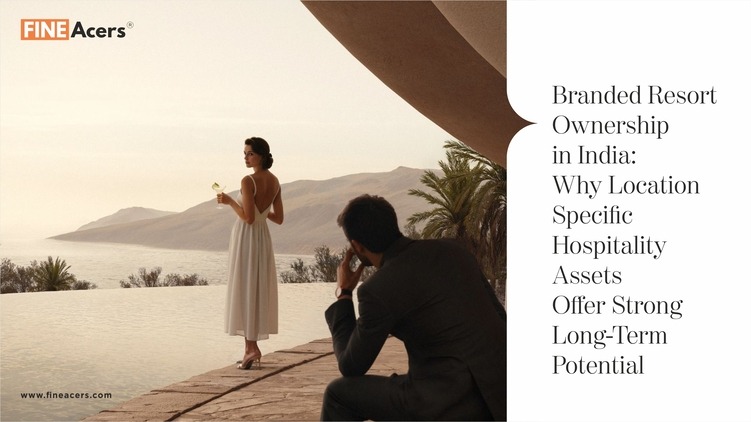
India’s hospitality and real estate sectors are undergoing a significant transformation. Investors are no longer looking only at traditional residential or commercial assets—they are increasingly shifting toward experience-driven, destination-led investments that combine lifestyle value with long-term financial growth.
At the center of this shift lies a rapidly growing segment: branded resort ownership.
From the serene hills of Coorg to the lakefront luxury of Udaipur and the wildlife landscapes of Jawai, location-specific hospitality assets are emerging as one of the most compelling investment opportunities in India’s evolving real estate ecosystem.
But what makes these assets so powerful?
And why are investors increasingly choosing branded resort ownership over conventional property investments?
The Shift from Traditional Real Estate to Experiential Assets
For decades, real estate investments in India revolved around:
- Residential apartments
- Commercial office spaces
- Plotted developments
While these asset classes continue to exist, investor behavior has evolved significantly.
Modern investors now seek:
- Passive income opportunities
- Lifestyle-driven ownership
- Professionally managed assets
- Long-term appreciation linked to tourism and demand
This is where branded resort ownership creates a unique advantage.
Unlike static real estate assets, hospitality-led investments are driven by:
- Tourism growth
- Destination demand
- Experience economy
- Premium hospitality branding
This creates an ecosystem where the asset not only appreciates but also actively performs.
Why Location Matters More Than Ever
In hospitality investments, location is no longer just a geographical factor—it is the foundation of the entire investment model.
The success of a resort asset depends heavily on:
- Tourism demand
- Accessibility
- Cultural and experiential appeal
- Long-term destination relevance
This is why destinations such as:
- Udaipur
- Jaipur
- Goa
- Coorg
- Jawai
- Pushkar
- Sakleshpur
are gaining immense investor attention.
These destinations offer something beyond infrastructure—they offer emotion, experience, and aspirational value.
A luxury resort in a high-demand tourism ecosystem naturally benefits from:
- Higher occupancy potential
- Premium pricing
- Brand visibility
- Strong appreciation over time
The Rise of Branded Hospitality Assets
One of the biggest developments in the hospitality sector is the increasing importance of branding.
Branded resort assets create:
- Operational credibility
- Standardized guest experiences
- Higher market trust
- Better long-term positioning
For investors, branded hospitality means:
- Professional management
- Higher investor confidence
- Stronger demand retention
- Better scalability
This is why globally aligned hospitality developments continue to outperform unstructured hospitality assets in premium segments.
India’s Tourism Boom Is Driving Hospitality Growth
India’s tourism and hospitality industry is witnessing strong long-term expansion.
Key drivers include:
- Rising domestic tourism
- Growth in experiential travel
- Increasing spending on luxury stays
- Expansion of destination-based tourism
States like Rajasthan and Karnataka are seeing massive growth in tourism-driven infrastructure and hospitality demand.
The result?
Location-specific resort assets are becoming increasingly valuable—not just as properties, but as income-generating ecosystems.
Hospitality Assets Offer More Than Just Returns
One of the biggest reasons behind the popularity of branded resort ownership is the blend of:
- Financial value
- Lifestyle value
- Emotional value
Unlike conventional investments, hospitality assets offer experiences alongside returns.
Investors often gain access to:
- Annual stay privileges
- Lifestyle benefits
- Hospitality experiences
- Premium destination access
This creates a completely different ownership experience—one where the asset becomes part of the investor’s lifestyle.
The Advantage of Destination-Led Demand
A location-specific hospitality asset performs because the destination itself performs.
For example:
- Udaipur benefits from heritage and luxury tourism
- Jawai thrives on wildlife and experiential travel
- Goa remains one of India’s strongest leisure destinations
- Coorg and Sakleshpur are growing rapidly through nature-centric tourism
As tourism demand rises, hospitality assets within these ecosystems naturally strengthen in value.
This creates:
- Better long-term appreciation
- More resilient demand cycles
- Greater scalability for branded developments
The Evolution of Hospitality Investment Models
The hospitality sector has also become more investor-friendly through modern ownership structures such as:
- Fractional ownership
- Co-ownership
- Sale-Lease-Back (SLB) models
- Professionally managed resort investments
These models reduce operational complexities while enabling investors to participate in premium hospitality ecosystems.
This shift is making resort ownership:
- More accessible
- More structured
- More scalable
Why Long-Term Potential Remains Strong
Several long-term macro trends continue to support branded resort investments in India:
1. Rise of Domestic Luxury Tourism
India’s affluent travel segment is expanding rapidly.
2. Limited Premium Inventory
High-quality branded hospitality supply remains limited in many emerging destinations.
3. Experience Economy Growth
Travelers increasingly prioritize experiences over material consumption.
4. Infrastructure Expansion
Improved roads, airports, and connectivity are opening new destinations.
5. Global Hospitality Interest
International hospitality brands continue expanding into India’s tourism-driven markets.
Together, these trends position branded resort ownership as a future-ready asset class.
The Future of Hospitality Investment
The next decade of hospitality investment will not be driven by generic developments—it will be driven by:
- Destination relevance
- Experience-led hospitality
- Brand strength
- Structured investment ecosystems
Location-specific hospitality assets represent the intersection of:
- Real estate
- Tourism
- Luxury lifestyle
- Long-term wealth creation
And this is exactly why branded resort ownership is becoming one of the most promising investment categories in India today.
Conclusion
Branded resort ownership is no longer a niche concept—it is rapidly emerging as a strategic investment approach for modern investors seeking more than traditional returns.
In a world driven by experiences, tourism, and aspirational living, location-specific hospitality assets offer:
- Strong appreciation potential
- Professionally managed ecosystems
- Lifestyle-driven ownership
- Sustainable long-term value
Because in hospitality investments, success is not defined by the asset alone—
it is defined by the destination behind it.